

Configuration
Grant is configured via environment variables. The Config app is the recommended way to view and edit them; it writes to a single root env file at a time (.env, .env.demo, or .env.test).
Config app
If you already started development with pnpm dev, the Config app is already running at http://localhost:3005.
If you only want the Config app, start it from the repo root:
pnpm --filter grant-config devThen open http://localhost:3005.
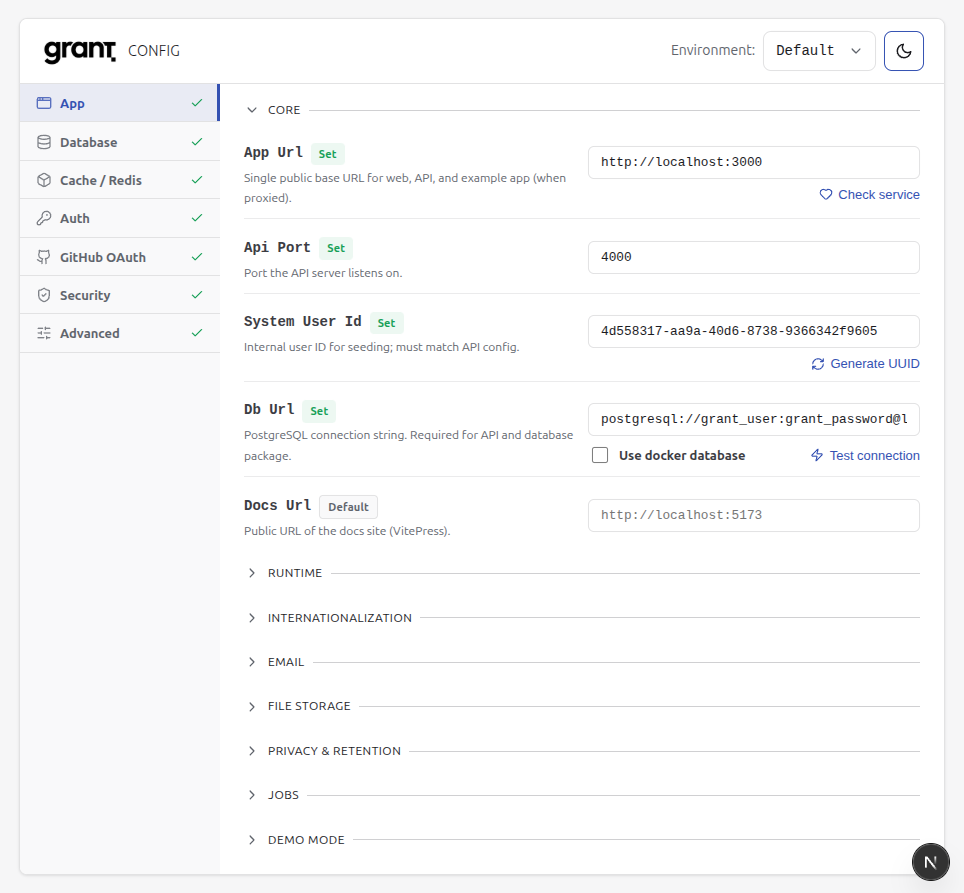
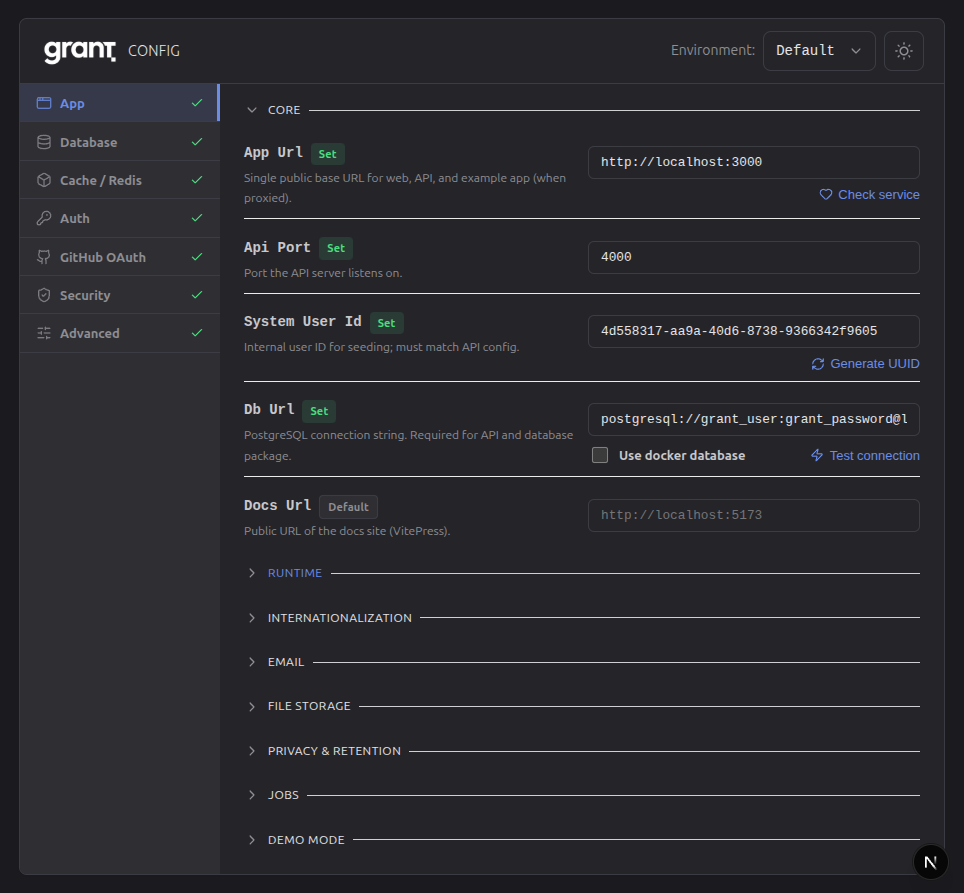
- Environment selector (header): Choose Default (
.env), Demo (.env.demo), or Test (.env.test). All vars and schema defaults are shown; unset vars show the default as placeholder. - Sidebar: Categories (App, Database, Cache, Auth, GitHub OAuth, Google OAuth, Security, Advanced) with Set/Default/Missing status. Hamburger menu on small screens.
- Content: Variables for the selected category in collapsible sections. Critical settings first; optional sections collapsed by default. Edit in place, generate passwords; optional Use app URL and Use docker database to derive
SECURITY_FRONTEND_URLandDB_URLfromAPP_URLand Postgres vars.
TIP
Root .env is created automatically when you run pnpm dev (predev script). To create or refresh without starting the app: pnpm env:setup. For deploy and E2E, use .env.demo and .env.test (copy from .env.demo.example / .env.test.example). You can also edit env files directly.
Env file precedence
The platform loads env files from the monorepo root in this order (later overrides earlier):
.env.env.local(usually gitignored).env.{NODE_ENV}(e.g..env.development,.env.test,.env.production).env.{NODE_ENV}.local(e.g..env.development.local, usually gitignored)
Only @grantjs/env loads these files; no need for dotenv-cli in scripts. Apps and DB scripts use getEnv() from @grantjs/env. The Config app and deployment use root .env, .env.demo, and .env.test only; apps consume these via @grantjs/env (no per-app .env for platform config).
Platform env rules
To avoid regressions, follow these rules:
- Only
@grantjs/envloads.envfiles — nodotenv.config()in apps or packages. - Apps never call
dotenvdirectly — env is loaded when the env package is first imported. - Apps never read
process.envdirectly — use typed config from@/configorgetEnv()from@grantjs/env. - All env access goes through
getEnv()(or the app’s derived config that uses it).
What to set
| Priority | Variable | Purpose |
|---|---|---|
| Required | DB_URL | PostgreSQL connection string |
| Required | SECURITY_FRONTEND_URL | Frontend URL for CORS (production) |
| Common | APP_URL | API base URL (JWT issuer) |
| Common | CACHE_STRATEGY | memory or redis |
Full list, descriptions, and defaults: Config app (all categories) or root .env.example (and .env.demo.example / .env.test.example for demo/E2E). Variables use prefixes (DB_*, JWT_*, SECURITY_*, etc.) for grouping.
Sign-in providers (optional)
Leave client ID and secret empty to hide that provider on login and register. If either value is set, both are required.
| Variable | Purpose |
|---|---|
GITHUB_CLIENT_ID / GITHUB_CLIENT_SECRET | GitHub OAuth App |
GOOGLE_CLIENT_ID / GOOGLE_CLIENT_SECRET | Google Cloud Web client |
Callback URLs default from APP_URL. Register them with the IdP as described in Sign-in providers and Security.
Authentication assurance (AAL)
| Variable | Default | Purpose |
|---|---|---|
AUTH_MIN_AAL_AT_LOGIN | aal1 | Minimum authentication assurance for general API access after login when the user has MFA enrolled. Use aal2 to require MFA verification (step-up) before most routes. |
AUTH_MFA_STEP_UP_MAX_AGE_SECONDS | 0 | When AUTH_MIN_AAL_AT_LOGIN is aal2, session JWTs with AAL2 whose mfa_auth_time is older than this many seconds are treated as AAL1 for route policy (time-based MFA step-up). 0 disables. |
Session access tokens include amr, acr, and auth_time claims. Prefer config.auth.minAalAtLogin in code (derived from the above).
Using config in code
The API reads env via a centralized, type-safe config:
import { config } from '@/config';

config.app.port; // number
config.db.url; // string
config.cache.strategy; // 'memory' | 'redis'Implementation: apps/api/src/config/env.config.ts. Validated on startup; invalid config throws before the server listens.
Troubleshooting
| Issue | Check |
|---|---|
| Env not loading | .env at repo root, restart server |
| Validation error on startup | Message names the variable; fix in Config app or .env |
| Redis unreachable | CACHE_STRATEGY=redis → verify Redis running, REDIS_HOST / REDIS_PORT / REDIS_PASSWORD |
| CORS errors | Set SECURITY_FRONTEND_URL (and SECURITY_ADDITIONAL_ORIGINS if needed) |
Related
- Quick Start — Get running locally
- Docker Deployment — Infrastructure and env
- Security — Auth, CORS, OAuth callback URLs
- Sign-in providers — GitHub/Google env, account linking, profile pictures
- Caching — Cache strategy and Redis
Next: Integration Guide to protect your API with Grant.